Why Can Globalization Lead to Radically Unequal Economic Growth
Economic globalization is i of 8 types of globalization. It refers to the ways in which global economies have become integrated through growing business, trade and fiscal interdependence.
Elements of economic globalization include:
- Rising of Multinational Corporations
- Movement of Manufacturing Industries to Developing Nations
- Growth of Financial Hub Cities in Developed Nations
While nosotros usually refer to modern examples of economical globalization (as it is more extreme than ever), the globalization of our economies has been going on for centuries. An instance of this is the rise of the tea trade from Bharat to England facilitated by the East Bharat Company that was founded in 1600.
At that place accept been both positive and negative effects of the economic integration of the world's economies. A positive is increased prosperity of the world overall. A negative is the widening gap between the rich and poor.
Economic Globalization
Definition & Simple Explanation
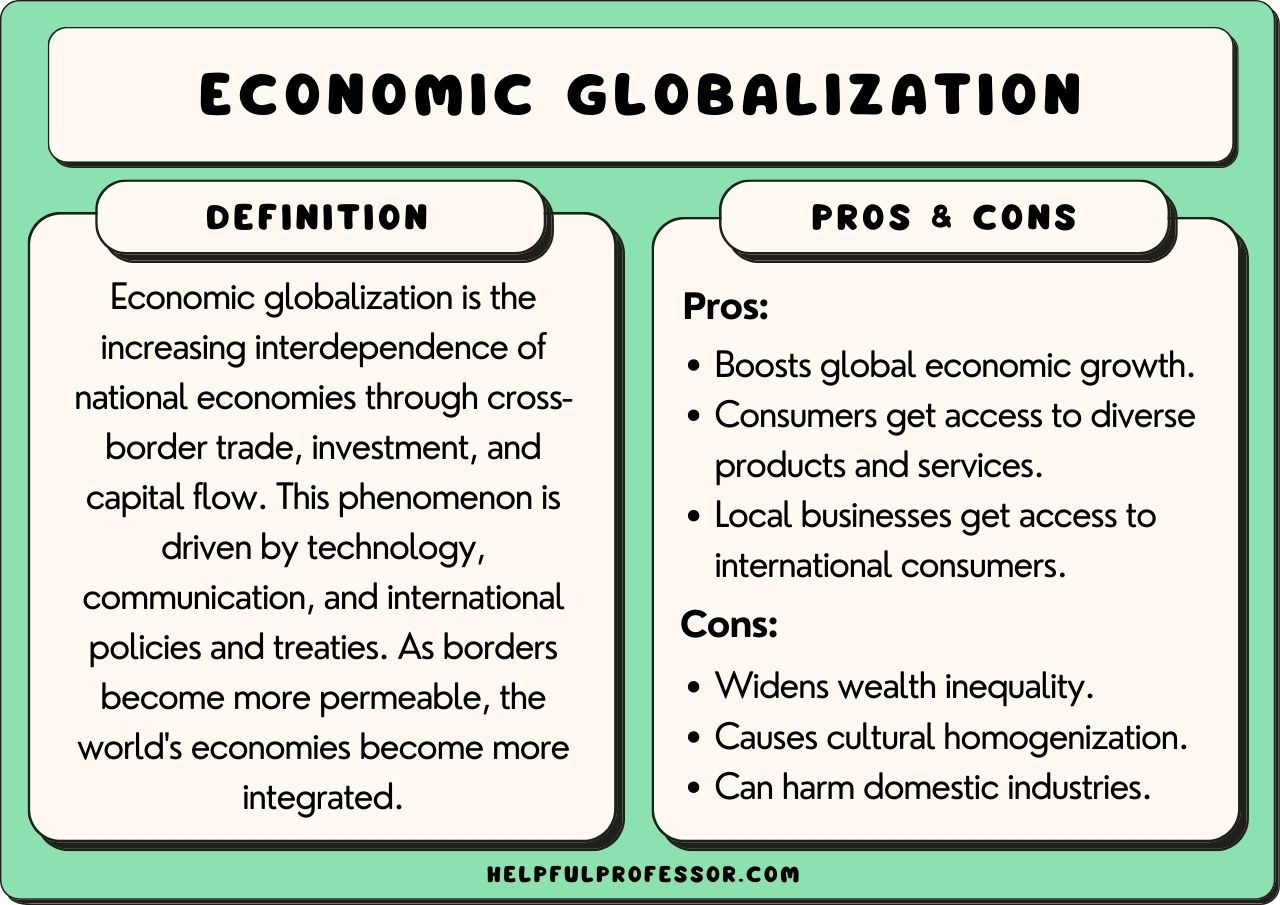
Economic globalization is the element of globalization concerned with how our economies have become increasingly interconnected. As our world has become more than interconnected (thanks to faster motion of goods and people as well equally high-speed telecommunication), businesses take made the about of this to engage in cross-border commerce.
Economic integration includes the integration of:
- Goods – Including the production and sale of products and their parts across international borders.
- Services – Including increased movement of labor and the growth of international service providers such as phone call centers moving overseas.
This integration sped upwardly toward the second one-half of the 20th Century and its growth continues to this day.
Examples of Economic Globalization
Examples include:
one. Ascent of Multinational Corporations
Multinational corporations include Coca-Cola, McDonalds, Amazon and Google. Globalization of economies has often allowed multinational corporations to move to offshore tax havens and depression-tax nations to minimize their revenue enhancement responsibilities to society.
Multinational corporations have existed for centuries. The Eastward India Visitor, for example, (established in 1600) used to merchandise teas and spices from Asia to Europe.
Nevertheless, it has become increasingly piece of cake for corporations to conduct international business thanks to revenue enhancement treaties to help corporations avoid double taxation, costless trade agreements such as NAFTA, and faster movement of goods and services.
Related Concept: McDonaldization
2. Internationalization of Capital Markets
The growing ease with which companies (and individuals) tin can move coin overseas has led to international capital markets. In brusk, this means companies overseas can fund businesses all effectually the world. This was labelled past Arjun Appadurai as 'financescapes'.
At present, an entrepreneur can get cheap low-repayment funding from overseas to set up a business venture. Similarly, overseas buyers tin can flood a real manor market to buy upwardly houses in international cities like Vancouver BC or Melbourne Australia. This can inflate housing prices for locals.
Similarly, Chinese industries have been quite aggressive in buying up farming state and industries around the world – which has led to some backlash from locals who feel every bit if local state should be owned by local people.
iii. Movement of Manufacturing Overseas
The past few decades have seen massive closing-downward of manufacturing industries in developed nations. Those industries have been moved offshore, such as to Mexico, Vietnam and China, where labor regulations are sometimes less stringent and wages are lower.
Now, if you lot look at the label on your clothing or electronics, you'll often see a "Made in China" label.
This has allowed united states to get cheaper goods, merely has led to backlash from activists who have seen entire industries for blueish neckband workers collapse in developed nations. Some could besides claim the quality of the goods may exist affected if manufactured in countries with lower quality standards.
4. Internationally Mobile Labor Forces
White collar jobs in finance, engineering and related industries have benefited from globalisation. Those with in-demand skills tin can discover work across the world before fifty-fifty stepping on an aeroplane and travel internationally for 12- to 36- calendar month stints to behave work overseas.
This concept of migration for work is not new. New world nations like the United States are built on movement of people seeking economic mobility. The major recent change has been the speed and ease with which this movement tin happen for those with in-need skills.
5. Rise of 'Hub' Cities
Every bit the globe's economies take become increasingly intertwined, nations accept developed expertise in specific industries. This is known as the development of 'economies of calibration' and leads to improved productivity.
1 event of this is that there are at present hub cities effectually the world focused on particular industries. London is known as a finance hub, Los Angeles for technology (encounter as well: technological globalization), and Seattle for aviation.
6. Worldwide Booms and Busts
A globalized economy means that each economy effectually the world is dependant on the success of others. Thus, a recession in one nation may accept a flow-on effect and cause a recession in others. The Great Depression and the Global Financial Crisis are two examples where economic issues in one part of the earth (such as the United States) can lead to economic woes all around the earth.
Advantages of Economic Globalization
1. Cheaper Goods
Multinational corporations can move their manufacturing industries overseas to nations where the cost of production is depression.
two. Economies of Scale (Efficiency)
Larger (multi-national) corporations tin produce products in bulk. This can create economies of calibration, which ways the price of goods goes down as the number of goods you lot produce goes up. For example, Wal-Mart can often become appurtenances to market a lot cheaper than your local corner store.
3. Increased Prosperity
Proponents of globalization say that it has increased overall prosperity in the world. When manufacturing industries move overseas, those people in those developing nations get jobs and can exist lifted out of relative poverty, while people in the developed world become cheaper goods. This is the 'rising tide lifts all boats' argument. Critics disagree – and that'south discussed in the 'disadvantages' section below.
four. Cheap Coin
Entrepreneurs can get financed from international financiers (such as Chinese investors) at low interest rates. The large puddle of potential investors in a global market means you can seek out very cheap money. Information technology forces downward force per unit area on interest rates and makes information technology easier for you to borrow money to commencement a business.

Disadvantages of Economic Globalization
i. Loss of Manufacturing Jobs in Developed Nations
Globalization inevitably leads to the movement of industries to achieve economies of calibration. Manufacturing industries have been the biggest losers in recent decades. The NAFTA agreement, for example, led many US-based manufacturers to relocate to United mexican states.
Widespread political backlash to loss of protected industries is evident around the globe. Detractors contend for a render to nationalist and protectionist policies. One prime number example is Brexit – the get out of the U.k. from the European Union – which was in part due to the loss of the line-fishing manufacture during the United kingdom of great britain and northern ireland's participation in the Eu trade bloc.
> Run across Besides: Political Globalization
2. Exploitation of Developing Nations
Goods are cheaper to produce in developing nations because they often have lower wages and worker protections. The cheap goods that come out the other terminate – and cease upward on our doorstep – are often produced in sweatshops for extremely low wages with few days off, residue breaks, or safety standards.
Here, there is a fence between the fact developing nations are request for these jobs (the countries often take high unemployment) and the fact nosotros have to exist responsible consumers who don't exploit nations that do non have worker protections.
3. International Interdependence
Critics of globalization say that information technology's led nations to be overly dependent on international supply bondage. This was evident, for example, during the Covid-19 pandemic, when many adult nations were unable to produce vaccines. All their vaccine product facilities had moved overseas for cheaper labor.
Similarly, during war time, all nations need to be able to produce food and weapons within the nation to sustain them throughout the war. Many nations are unlikely to be able to do this today.
4. Tax Evasion
The internationalization of the economy has allowed many companies to move offshore to avoid taxes. Some smaller nations the need tax revenue offer low-revenue enhancement incentives for large corporations to move to their low-tax nations. Larger nations try to match these tax decreases, creating a global 'race to the bottom'. The cyberspace effect of this is to lower corporate tax rates worldwide, leaving nations with less revenue enhancement revenue to spend on social services.
v. Climate Change and Environmental Impacts
An international economy could have pregnant bad effects on the environment. Appurtenances have much greater distance to motion, leading to greater carbon footprints for products. Some may as well debate that products are also lower quality, meaning they get trashed sooner – leading to greater amounts of landfill. Lastly, multinational companies can avoid environmental responsibilities past operating in nations with relaxed environmental laws – again leading to ecological harm.
Related: Cultural Globalization Pros and Cons
Decision
Economic globalization has been occurring for centuries, but has grown significantly in recent years thanks to merchandise liberalization and increasing speed of communication and travel. Nosotros now live in an integrated global economy that is heavily interdependent.
There are some cracking advantages of economical globalization such as cheaper goods, economies of calibration, and the spread of valuable consumer goods around the world. But in that location are too some meaning downsides besides, such every bit potential for exploitation of labor in developing nations and the loss of working-class jobs in developed nations.
References
Cavanagh, J. (2004). Alternatives to economical globalization: A better world is possible. New York: Berrett-Koehler Publishers.
Gallagher, K. P. (2009). Economical globalization and the environment.Annual Review of Surroundings and Resources,34, 279-304.
Sachs, J. D. (2020).The Ages of Globalization: Geography, Technology, and Institutions. U.s.a.: Columbia Academy Printing.
Sen, Southward., & Barry, C. M. (2020). Economic globalization and the economic policy positions of parties.Party Politics,26(2), 154-164.
Steger, M. B. (2017).Globalization: A very brusk introduction(Vol. 86). England: Oxford University Printing.
Ying, Y. H., Chang, Thou., & Lee, C. H. (2014). The impact of globalization on economical growth.Romanian Journal of Economic Forecasting,17(ii), 25-34.
Source: https://helpfulprofessor.com/economic-globalization-examples-pros-cons/

Post a Comment for "Why Can Globalization Lead to Radically Unequal Economic Growth"