When the Clock Stopped Never to Go Again
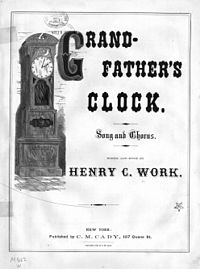
"Grand-Male parent'south Clock" was first published in 1876.
"My Grandfather's Clock" is a song written in 1876 by Henry Clay Work, the writer of "Marching Through Georgia". Information technology is a standard of British brass bands and colliery bands, and is too popular in bluegrass music. The Oxford English language Dictionary says the vocal was the origin of the term "grandfather clock" for a longcase clock.[one] In 1905, the primeval known recording of this vocal was performed by Harry Macdonough and the Haydn Quartet (known then as the "Edison Quartet").
Storyline [edit]

It was in this Piercebridge hotel that the writer encountered a remarkable clock that inspired the song.
The song, told from a grandchild's point of view, is nigh their grandfather's clock.
The clock is purchased on the morning of the gramps's birth and works perfectly for xc years, requiring simply that it be wound at the end of each week.
Nevertheless the clock seems to eerily know the good and bad events in the granddaddy's life – as it rings 24 chimes when the grandfather brings his bride into his house, and near his death it rings an eerie warning, which the family unit recognizes to mean that the grandfather is most expiry and gathers past his bed. Subsequently the grandfather dies, the clock of a sudden stops, and never works again.
Sequel [edit]
Work published a sequel to the song 2 years after, and again the grandson acts as the narrator. The grandson laments the fate of the no-longer-performance grandfather clock – it was sold to a junk dealer, who sold its parts for scrap and its example for kindling. In the grandfather'south house, the clock was replaced past a wall clock, which the grandson disdains (referring to information technology every bit "that vain, stuck-up thing on the wall"). Nonetheless, the sequel never reached the popularity of the original.[2]
The song was covered and translated many times, versions in other languages may vary. For example, in the Czech version, sung by the state band Taxmeni, the song continues with an additional, joyful strophe, narrating further events in the grandson's life: the birth of his son and the purchase of a new clock on the same twenty-four hours, to maintain the family unit tradition.[three]
Covers and inspirations [edit]
"My Grandfather's Clock" was often played in Uk on Children'southward Favourites and during that period[ when? ] was recorded by the Radio Revellers. In the United States, a version, without the last stanza of lyrics, was on an extended-play 45 rpm record on the Peter Pan characterization (the other song on that side was "The Syncopated Clock", and the flip side had "The Arkansas Traveler" and "Red River Valley"). Evelyn Knight recorded the song for Decca Records in 1945. Johnny Greenbacks covered the song on his 1959 album Songs of Our Soil, as did Tennessee Ernie Ford on Gather 'Round the aforementioned yr. Too in 1959, information technology was included on The 4 Lads' anthology, Swing Forth. Other versions became popular in other countries; it is well known to many generations in Japan, with a cover past singer Ken Hirai becoming massively popular in 2002.
In March 1961, on his album Swing Low, Sam Cooke did a rendition of the vocal.
Bing Crosby included the song in a medley on his album 101 Gang Songs (1961).
The vocal was the inspiration for the 1963 Twilight Zone episode "Ninety Years Without Slumbering".
The Big 3 recorded the vocal in their album Live at the Recording Studio in 1964
A popular clock toy, marketed by Fisher-Toll from 1962 to 1968, had a dial on it that, when turned, acquired the music box mechanism in the toy to play the vocal along with clock-similar ticking and moving hands on the face of the clock. An updated version of the toy (which is completely made of plastic and with other activities like a clicking plastic mouse on the side) has been manufactured by Fisher-Price since 1994. Imitations of the toy made by diverse companies exist and are sold in various countries worldwide.
Jon Pertwee recorded a version in 1966 for the children'due south album Children'due south Favourites, on the Music for Pleasure record label.
John Fahey recorded a solo guitar version on his 1967 album Days Take Gone By.[iv]
Joan Morris recorded it in 1975, on Who Shall Rule This American Nation (Nonesuch), an anthology of songs by Work.
In 1983, Fred Penner, a Canadian children's entertainer, covered "My Grandpa'due south Clock" on the LP anthology Special Delivery, which was later rereleased as Ebenezer Sneezer on CD in 1994.
A version of the song was recorded past Scarlet Grammar on his 1994 family music recording, Down The Do Re Mi.
It was parodied as "My Grandfather'due south Grunge" by the Kenneth Williams character Rambling Syd Rumpo on the BBC radio show Round the Horne.
It was amongst the popular folk songs parodied past Allan Sherman in his medley song, "Shticks and Stones (Shticks of One, Half a Dozen of the Other)."
Garrison Keillor and the cast of the radio testify A Prairie Habitation Companion recorded a parody titled "My Grandmother'southward Cat," telling the story of an old woman who overfed her cat until it was big enough to knock her downwards and try to swallow her.
The tune was used in the track "I'thousand Not Edible" from the soundtrack of the 2000 game American McGee's Alice, composed by Nine Inch Nails drummer Chris Vrenna.
"My Grandfather's Clock" is a playable song in the 2008 video game Wii Music.
This song was as well used in the game, Five Nights at Freddy'southward two, made past Scott Cawthon, which was released on 10 Nov 2014. The chorus of the vocal plays whenever a music box is wound upwards to keep i animatronic character away; whereas, the other antagonists are unaffected past it.
It was also sung past Maple and Cinnamon in the tertiary volume of Nekopara visual novel series.
Original Lyrics [edit]

The City Green in Wedlock Park of Middletown, Connecticut includes this bust of the author nearly his birthplace.
My grandfather'south clock was likewise large for the shelf,
So it stood ninety years on the floor;
It was taller past half than the old man himself,
Though it weighed not a pennyweight more.
Information technology was bought on the morn of the twenty-four hour period that he was born,
And was e'er his treasure and pride;
But information technology stopp'd curt — never to go again —
When the old man died.
- Xc years without slumbering
(tick, tick, tick, tick), - His life seconds numbering,
(tick, tick, tick, tick), - Information technology stopp'd brusque — never to go again —
- When the old man died.
In watching its pendulum swing to and fro,
Many hours had he spent while a male child.
And in babyhood and manhood the clock seemed to know
And to share both his grief and his joy.
For information technology struck twenty-four when he entered at the door,
With a blooming and beautiful helpmate;
But it stopp'd short — never to become again —
When the one-time man died.
- Ninety years without slumbering
(tick, tick, tick, tick), - His life seconds numbering,
(tick, tick, tick, tick), - It stopp'd brusque — never to get again —
- When the sometime human died.
My grandfather said that of those he could hire,
Non a retainer so faithful he plant;
For it wasted no time, and had simply one desire —
At the shut of each calendar week to exist wound.
And it kept in its place — not a pout upon its face,
And its hands never hung past its side.
But it stopp'd short — never to go again —
When the former human died.
- Ninety years without slumbering
(tick, tick, tick, tick), - His life seconds numbering,
(tick, tick, tick, tick), - Information technology stopp'd brusque — never to go again —
- When the old human being died.
It rang an warning in the dead of the night —
An alarm that for years had been dumb;
And we knew that his spirit was pluming for flight —
That his 60 minutes of divergence had come.
Yet the clock kept the fourth dimension, with a soft and muffled chime,
As we silently stood by his side;
Only information technology stopp'd short — never to get again —
When the erstwhile man died.
- Ninety years without slumbering
(tick, tick, tick, tick), - His life seconds numbering,
(tick, tick, tick, tick), - It stopp'd brusk — never to go again —
- When the one-time man died.[5] [6]
References [edit]
- ^ "Oxford English Dictionary" (bachelor online to subscribers, also in impress) . Retrieved 19 April 2009.
Grandfather's clock [suggested by a vocal which was popular almost 1880], a piece of furniture-dealer's proper name for the kind of weight-and-pendulum eight-mean solar day clock in a tall case, formerly in mutual apply; as well grandad clock (now the usual name): [1876 H. C. WORK Granddad'due south Clock, My grandfather's clock was also big for the shelf, And so it stood ninety years on the floor.]
- ^ "Sequel To MY Grandfather'S CLOCK - 1878 - Tom Roush". 21 January 2015. Archived from the original on 21 December 2021. Retrieved 7 November 2019 – via YouTube.
- ^ Taxmeni (1977). "Dědečkovy hodiny". Archived from the original on 21 December 2021 – via YouTube. Czech encompass version of My Granddad's Clock
- ^ ELGROOVER (31 Baronial 2009). "My Grandpa'due south Clock - John Fahey". Archived from the original on 21 December 2021. Retrieved 10 March 2019 – via YouTube.
- ^ Henry C. Piece of work (1876). "Grandfather's clock". New York: C. M. Cady. Retrieved 5 May 2012.
original publication uses "tick, tick, tick, tick", "tock" was added later
- ^ "History of the Granddad Clock". The Clock Depot. Archived from the original on 16 March 2015. Retrieved 29 June 2012.
- Zecher, Henry (Oct 2005). "How an old flooring clock became a grandad". The Pride of Olney (Lion's Club of Olney, Maryland) 30 (76). Retrieved 12 August 2013. on Henry Zecher'due south personal website
External links [edit]
- Score
- 1905 recording from the Net Annal
- Story of the clock
- {https://www.phrases.org.uk/meanings/grandfather-clock.html}
- {https://findhistoryhere.com/history-of-the-grandfather-clock}
Source: https://en.wikipedia.org/wiki/My_Grandfather%27s_Clock

Post a Comment for "When the Clock Stopped Never to Go Again"