When Will the Halleys Comet Appear Again
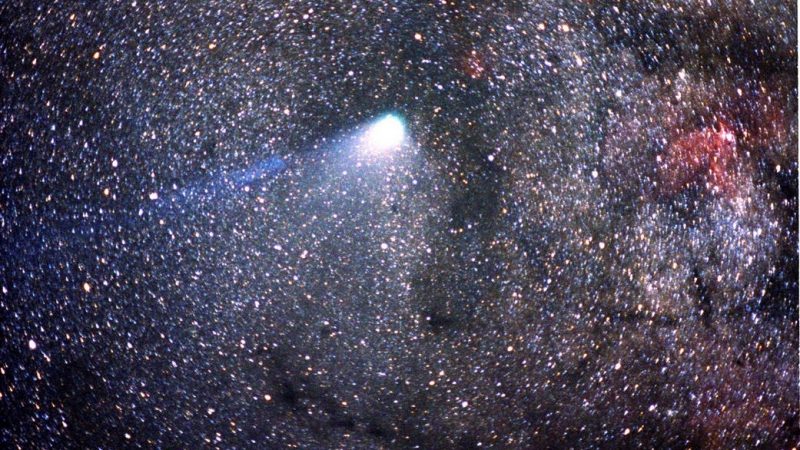
How Halley's Comet became famous
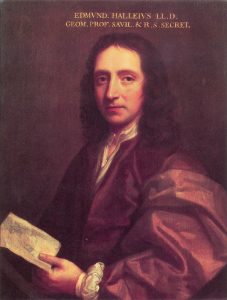
English language astronomer and mathematician Edmond Halley was born on Nov 8, 1656, near London. He became the offset to calculate the orbit of a comet, still one of the about famous of all comets today, named Comet Halley in his honor. He was also friends with Isaac Newton and contributed to Newton's evolution of the theory of gravity, which helped found our modern era of science, in function by removing all doubt that we live on a planet orbiting around a sun.
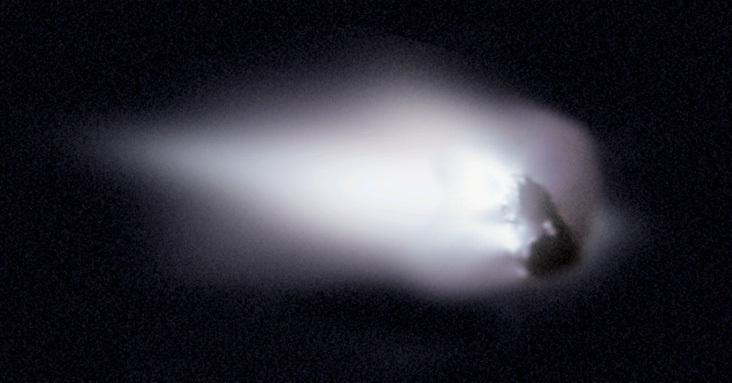
When Halley'south Comet terminal appeared in World's skies in 1986, it was met in space by an international armada of spacecraft. This famous comet will return again in 2061 on its 76-twelvemonth journey around the sun. It'south famous partly considering it tends to be a bright comet in Earth's skies. And the length of its orbit – 76 years – isn't and then different from that of a man lifespan. So, for most people, seeing Comet Halley is a once-in-a-lifetime opportunity.
But it'south also famous for some other reason. That is, in Edmond Halley'southward fourth dimension, people didn't know that comets were like planets in being spring in orbit past the sun. They didn't know that some comets, similar Comet Halley, return over and over. Comets were idea to pass but once through our solar system.
In the year 1704, Halley became a professor of geometry at Oxford Academy. The following year, he published A Synopsis of the Astronomy of Comets. The volume contains the parabolic orbits of 24 comets observed from 1337 to 1698.
And information technology was in this volume that Halley made his magnificent prediction.
EarthSky'due south 2022 lunar calendars are available now! We're guaranteed to sell out, so get ane while you tin. Your support helps EarthSky go on going!
Halley's magnificent prediction
In his book, Halley remarked on three comets that appeared in 1531, 1607, and 1682. He used Isaac Newton's theories of gravitation and planetary motions to compute the orbits of these comets. Remarkable similarities appeared in their orbits. Then Halley made a bound and made what was, at that time, a stunning prediction. He said these three comets must in fact exist a single comet, which returns periodically every 76 years.
He then predicted the comet would return, saying:
Hence I dare venture to foretell, that it will return once again in the year 1758.
Halley didn't live to see his prediction verified. Information technology was 16 years after his death that – right on schedule, in 1758 – the comet did return, astonishing the scientific globe and the public.
It was the first comet ever predicted to return, and is now chosen Halley's Comet, in award of Edmond Halley.
Halley, Flamsteed and a Mercury transit
The 17th century was an exciting time to be a scientist in England. The scientific revolution gave nascency to the Royal Lodge of London when Halley was simply a child. Members of the Royal Society – physicians and natural philosophers who were some of the earliest adopters of the scientific method – met weekly. The beginning Astronomer Majestic was John Flamsteed, remembered in role for the creation of the Regal Observatory at Greenwich, which all the same exists today.
After entering Queen'due south College in Oxford as a student in 1673, Halley met Flamsteed. Halley had the chance to visit him in his observatory on a few occasions, during which Flamsteed encouraged him to pursue astronomy.
At that time, Flamsteed'south projection was to assemble an accurate catalog of the northern stars with his telescope. Halley thought he would do the same, but with stars of the Southern Hemisphere.
Halley's Southern Hemisphere expedition
His journey southward began in November 1676, even earlier he obtained his university degree. He sailed aboard a transport from the Due east India Company to the island of St. Helena, still one of the most remote islands in the world and the southernmost territory occupied by the British. His male parent and King Charles II financed the trip.
In spite of bad weather that made Halley's piece of work difficult, when he turned to sail back home in January 1678, he brought records of the longitude and breadth of 341 stars and many other observations including a transit of Mercury. Of the transit, he wrote:
This sight … is past far the noblest astronomy affords.

Cracking the code of planetary motion
Halley published his catalog of southern stars by the end of 1678, and – as the first piece of work of its genre – it was a huge success. No one had ever attempted to make up one's mind the locations of southern stars with a telescope before. The catalog was Halley's glorious debut equally an astronomer. In the same year, he received his M.A. from the Academy of Oxford and was elected a boyfriend of the Purple Society.
Halley visited Isaac Newton in Cambridge for the starting time time in 1684. A group of Imperial Society members, including physicist and biologist Robert Hooke, architect Christopher Wren and Isaac Newton, were trying to crack the lawmaking of planetary motion. Halley was the youngest to join the trio in their mission to use mathematics to describe how – and why – the planets move effectually the sun. They were all competing against ane some other to find the solution commencement, which was very motivating. Their problem was to discover a mechanical model that would go along the planet orbiting around the sunday without it escaping the orbit or falling into the star.
Hooke and Halley determined that the solution to this problem would be a strength that keeps a planet in orbit around a star and must decrease equally the inverse square of its distance from the star, what we today know every bit the inverse-square law.
Hooke and Halley were on the right rails, but they were not able to create a theoretical orbit that would lucifer observations, in spite of a monetary prize to be given past Wren.
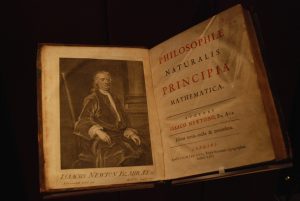
Halley visited Newton and explained the concept to him, as well explaining that he couldn't bear witness information technology. Newton, encouraged past Halley, developed Halley's work into one of the most famous scientific works to this day, Mathematical Principles of Natural Philosophy, often referred to simply equally Newton's Principia.
Halley became Astronomer Royal
Halley is also known for his work in meteorology. He put his talent of giving pregnant to great amounts of information to use by creating a map of the world in 1686.
The map showed the most important winds above the oceans, and is considered to be the start meteorological chart to exist published.
Halley kept travelling and working on many other projects, such equally attempting to link mortality and age in a population. This data became important for actuaries computing life insurance.
In 1720, Halley succeeded Flamsteed and became the second Astronomer Royal at Greenwich.

Bottom line: Astronomer Edmond Halley – for whom Halley's Comet is named – was born on November 8, 1656.
Source: https://earthsky.org/space/halleys-comet-and-edmond-halleys-prediction/

Post a Comment for "When Will the Halleys Comet Appear Again"